
This cartoon kind of happened to me on the weekend.
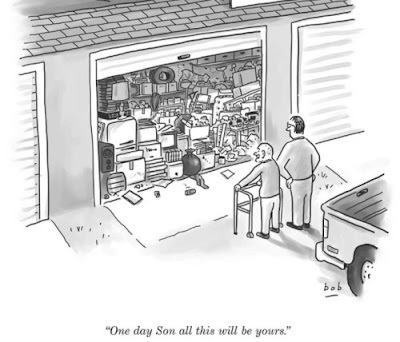
I was reminded of Marie Kondo, who says in her book that we have to deal with items either now or later; so it might as well be now. For people who have retired, I guess there's a third option: Ignore it for a few more decades and let descendants deal with it.
Don't get me wrong - my dad has plenty of years left yet. But from his joke I'm guessing he's reasonably happy to let it all sit there while he enjoys retired life.
There will also be stuff in there that will remind him of old times; when my sister and I were young and at home, and mum was alive. It can be tough to go through items like that, but holding onto the old family clothes dryer we no longer need isn't going to turn back time. If anything, selling it can help out a new young family who can't afford a brand new one.
In the meantime I'm going to check the library for the book The Gentle Art of Swedish Death Cleaning: how to free yourself and your family from a lifetime of clutter . I only know a little about it so far but the subtitle is exactly the situation. It's the accumulation items over decades. Maybe just one a week, but over the decades it adds up to a big burden if it isn't addressed.
I'll let you know how things go.

Joking about death
My dad has his own unique sense of humour. Flippantly he joked that when he passes away, the first thing I'll need to do is get a rubbish skip (maybe two) and jam it full with all the junk from the garage.I was reminded of Marie Kondo, who says in her book that we have to deal with items either now or later; so it might as well be now. For people who have retired, I guess there's a third option: Ignore it for a few more decades and let descendants deal with it.
Don't get me wrong - my dad has plenty of years left yet. But from his joke I'm guessing he's reasonably happy to let it all sit there while he enjoys retired life.
Why not deal with it?
I can kind of understand. It's an overwhelming task (even to look at). There's also the "I might need that" factor. Which is fair enough, but even if an item is needed, is it findable in amongst everything else? About half the garage looks like the cartoon above - so a great deal of it is practically inaccessible.There will also be stuff in there that will remind him of old times; when my sister and I were young and at home, and mum was alive. It can be tough to go through items like that, but holding onto the old family clothes dryer we no longer need isn't going to turn back time. If anything, selling it can help out a new young family who can't afford a brand new one.
What to do
I think this might be something where my dad would appreciate the assistance and support of his son. Not to takeover, just to help him if he wants to. I'll see if I can bring it up next time - maybe even give him a copy of my ebook Less Clutter More Cash. Not that he needs the cash, but I think he'd be surprised how easy it is to find people who would appreciate (and use) some of that stuff.In the meantime I'm going to check the library for the book The Gentle Art of Swedish Death Cleaning: how to free yourself and your family from a lifetime of clutter
 . I only know a little about it so far but the subtitle is exactly the situation. It's the accumulation items over decades. Maybe just one a week, but over the decades it adds up to a big burden if it isn't addressed.
I'll let you know how things go.

Loved the Swedish Death cleaning book.
ReplyDeleteIt is far better to downsize with parents when they are still alive and well enough to tell the stories that go with family stuff. And get rid of other stuff to folks who will use and appreciate them. ( In the middle of helping my family do the big clear out after Dad passed) It is a journey.
Thanks for that advice. It could be really meaningful to hear the stories behind some of the items. Particularly the items from a time before I can remember.
ReplyDeleteAlready started on the Swedish death cleaning at 44! My teens don't want our old stuff...neither do I
ReplyDelete